102 Review, Issue 2017-2-12: Respect for All (and Making Sure It Happens)

102 Review, Issue 2017-2-12: Respect for All (and Making Sure It Happens)

FEBRUARY 12, 2017 BY PGEBHARDT

“Ultimately, this report concludes that Wisconsin must honor its commitment to make a public education available to all of its students, but must not do so at the expense of the vast majority of pupils who do not engage in disruptive behaviors. Similarly, teachers must be supported and allowed to teach in an environment where their focus can be on student learning, not discipline.”

-Mike Ford, The Impact of Disruptive Students in Wisconsin Public Schools

There was a fantastic study two weeks ago I could no longer find, but the gist of it is simple: children learn how to behave mostly from the way their peers do, and not how the teachers and parents teach them.

When the majority of their classmates respect one another, children reliably learn how to do so. Conversely, when they observe classmates exhibiting disrespectful behaviors, the likelihood of them misbehaving increases.

Unfortunately, children who misbehave draw them most attention, and thus have the most impact. That’s why one hardworking student can never improve the behavior of 29 other students, but one unchecked misbehaving student can absolutely torpedo his/her entire grade.

The solution, obviously, is for educators to check their idealism and pragmatically remove the persistently misbehaving student from the general population. (This is all researched-based, by the way.)  So this Respect for All week (thank you for planning, Ms. Babakitis!), I urge all of us to identify the most-pressing behavior issues still persisting in each grade and let your APs know. The School Climate Team will have a mid-year review of our most critical “cases” this Friday and we’ll escalate our responses accordingly.

HIGHLIGHTS

Ms. Meenan, Ms. Danielski, Ms. Wyckoff, Ms. Monteleone, Ms. Listl, and Ms. Mercado, and Ms. Lee. To watch you expertly attend to explosive misbehaviors as you teach brings back memories of my mother wrangling with her own Hurricane William. Thank you, and your persistence is absolutely vital to the ones who need it most.

THINGS YOU NEED TO KNOW

INQUIRY SHOWCASE

AIS, School Events, and TechFlex: You’re Up. All staff please be ready to learn in the auditorium by 3PM.

OPERATION THANK YOU: I’ve heard that the Chancellor’s office were delighted by our Operation Thank You videos. Please upload them here; I’m creating a web gallery and we would like to share all of our photos and videos.

6TH GRADE TEACHERS: Effectively immediately, please direct all 6th grade students to use only the stairway by Ms. Mulé and Ms. Mintien’s office to and from lunch.

DISCRETIONARY SPENDING SEASON: I’ve been meeting with grade teams to determine how best to spend some of our discretionary budget. Instead of allocating funds to each teacher to make little purchases here and there, we’re aiming to be more intentional this time around with our Spring spending. Whether it’s furniture for the School Climate Team, per-session for planning, Whatever the Cohen’s need, TC books, chromebooks, or the Zecca’s Wish(es) foundation, we will take care of it because we are committed to removing as many obstacles from your work as possible. Help me help you. Go ahead, say, “Show me the_________” and I’ll do my best to oblige.
102 Review, 2017-1-22: Effective Thinking Generators

Of all the things we say about Thinking Generators, here are the two most important things you need to think about as you plan them:

1.) You must first know exactly the thinking you are trying to generate as well as how it will lead to new understanding relating to the target learning objective

2.) The TG is written so that there exist no alternative option for students but to think about what you intended 

Why? Because we can’t learn by listening to a teacher talk or explain; we need to think about ideas to learn them. If you disagree, tell me how much you’ve learned about non-commutable variables after a teacher lectures and tells you to copy this idea in your graphic organizer:

“A function of noncommuting variables is a function defined on tuples of matrices of all sizes that satisfies certain compatibility conditions as we vary the size of matrices: it respects direct sums and simultaneous similarities, or equivalently, simultaneous intertwinings.”

Right.

Likewise, for some 6th grade students, the following “knowledge”  can be as confusing as the prior example was to you:

“To clearly defines how a word or complex term is being used in a reading, both denotative and connotative meanings should be considered. Because of subtle differences in both denotative and connotative meaning, a reader’s misinterpretation of the author’s intent may undermine their ability to navigate the nuances of the text.”

So how can we use a Thinking Generator to help students really learn connotation? Let’s use Mr. Goldin’s class as a case study for aTG mini how-to guide.

THINKING GENERATOR HOW-TO: 6th Grade ELA:

(V)TG: To help his students appreciation the purpose of connotation and learn how to use it, first-year teacher uses the following vocabulary Thinking Generator: “How old does an artifact need to be in order to be considered ancient? How old does it need to be to be considered prehistoric?”

By asking students to consider the many degrees of “old”, he allows his students to internalize through a thinking experience that words with similar meanings are not interchangeable because of their implied intensity. This is  an effective thinking generator that does its job to help students think to learn.

Thinking Generators are effective when they are specific: teachers should be able to explain in great clarity exactly what they intend their students should cognitively wrestle with for each and every TG. In this example, Mr. Goldin wanted the students to recognize connotation as a tool for communicating varying degrees of a definition. However, to fully appreciate connotation, he also needs to teach his students that connotation is not just about degrees of intensity: one of the most common mistakes students make as they build their writing vocabulary is using words with inaccurate or unintended positive or negative connotations.

If Mr. Goldin’s target objective for the lesson is for students to consider connotation in their writing, he should pre-emptively address this misconception with the following THINKING GENERATOR:

TG 1: “Mr. Ko is childish” and “Mr.Ko is youthlike”. Which one would make him more angry?”

To differentiate and/or extend the TG:

TG 2: “Find at least 3 more pairs of words that shows the same difference between childish/youthlike”

To differentiate even more by adding a subtext of social studies:

TG 3: “Some people who live abroad are referred to as “expats” or expatriates. Some are called immigrants. How do we determine who to call which? Does it matter?”

With each of these examples, the teacher did none of the thinking for students. However, the teacher knows exactly students should and would think about. TGs cannot possibly be effective without this level of specificity because impactful lessons leave nothing to chance.

HIGHLIGHTS:

From Ms. Mulé:  Without solving, how can you tell that 7x= 3x +4x will have multiple solutions? This question leads students to consider more than simply solving the problem in a traditional way.  Students have to determine what possible solutions are to the problem before they come up with the answer.

From Mr. Borelli: Part of being a skillful reader is adapting to different styles of writing and an article presents a host of challenges: more hyphenated words, charts and graphs placed in the middle of a text that do not always align with the paragraph, and cryptic subheadings. Thinking about the style of writing and what challenges lay ahead can prepare a reader for a stronger understanding of the text. Ms. Buiyan’s TG “Does the layout of an article have an effect on the reader, how?” does exactly that.

From Ms. Mintiens: I had the pleasure of visiting a few Kindergarten classes this week. In Nancy Hafkin’s class the students were learning how to add those tricky vowels to words in their writing, in order to make their writing easier for readers to read. She used a piece of her own writing and made the Exersize interactive asking students to help her. She also brought out her word study vowel chart. These small moves subtly show students how what they’re learning in one part of their day seemlessly helps them in another.  Kindergarten students writing is soaring in part to strong practices such as these.

THINGS YOU NEED TO KNOW

Progress Reports: See this parent-facing memo for more info on Progress reports. With the exception of grades K and 1, all reports should go home by the end of January. NOTE: The purpose of these progress reports is to spark parental involvement: be ready for it.

Mid-Winter Intensive: Teachers who are interested in teaching 2 days, 4 hours each day, should email me to confirm. We are keeping the exact dates flexible, and will confirm once we have a core group of teachers.

Inquiry Groups Check In Tomorrow: Tomorrow we’ll get back to our inquiry work to prepare for our Showcase on 2/6. DO NOT OVER-PLAN for the presentation: Each group will have 10 minutes to describe their work, its implications, as well as take comments and questions. Groups will be able to schedule professional workshops for their colleagues at a later date; this Showcase is simply about sharing what you are working on, and what they can expect from you should there be a follow up workshop.

THINKING GENERATOR WALKTHROUGH: We’ll have our 4th TG walkthrough this week. We are getting better at delivering feedback, and we found that feedback is meaningless unless it is anchored to a shared learning objective. From now on we’ll note the IO in addition to the TG as we walk.

102 REVIEW, ISSUE 52: What Makes a Teacher (or a party planner) Highly Effective

THIS WEEK’S STAFF TG: What one piece of research would you look at to determine whether a teacher is highly effective or not? Do you look at a sample lesson plan? Student state test scores? Family surveys? Advance observations?

Personally, I’d say none of the above. Instead, I would randomly choose a student and ask the teacher what the student has specifically struggled with this year, why, and what they are doing about it. Good teachers assume nothing and confirm everything; While lesser educators consider a lesson to be done once it’s taught, highly effective teachers see learning as a give-and-take process, and not only do they never take for granted that students will always master what they was taught by the teacher, they assume the opposite is true. They are relentless in their search to uncover what and how students have failed to learn, and it’s fair to assume that by April each year they would know pretty much know how each student would succeed or fail at each standard.

Taking it a step further, I believe how well a teacher can predict student outcomes on state tests is a better indicator of their highly effective instruction than even if the students uniformly demonstrated incredible growth on these tests. Whether students actually learn or not depend on so many variables both in and out of schools, and it’s difficult if not impossible to evaluate a teacher on things they have little control over. And while strong lesson plans and direct instruction can certainly indicate preparation, it cannot show how well students learn as a result. In the end, it’s knowing exactly where students stand, what their last great hurdle was, or what the teacher is excited to do soon to try push each student over the hump that speak volume to both the intentions and expertise of the educator.

MONDAY: Even for highly effective teachers, looking only at your own data and classroom observations can only take you so far. On Monday teachers who elect not to engage in Inquiry work will meet with their respective grade level teams to surface and discuss trends in student progress, behavior, new noticings and concerns, and most importantly, students whom you believe to be significantly off track and will most likely not meet the year’s expectations (1’s and low 2’s). Share this information with their other teachers–clusters included–and confirm whether there are discrepancies in performance for different content areas. This is important for three primary reasons:

1) Intervene: To better focus the delivery of intervention (i.e. students with low math and high ELA should engage mostly in 102+ on math days as well as use Khan Academy and not Lexia during TechFlex);

2.) Identify students who have significant discrepancies–unexpected under-achievement–between content areas. This is one of the many indicators of a potential Learning Disability, and our timely recognition of such gaps in students (3-4 in math, 1 in ELA) will have immense impact both now and in the future if that’s the case.

3.) Shepherd: When teachers can speak to students about their performance in classes they do not teach, students will understand that adults talk about them outside of class, and better realize that we care and that they have meaning in our lives beyond the classroom and our profession. Students don’t care about meeting the expectations set by those they do not trust, and for students who may be in difficult family situations, knowing that a team of adults here have genuine concern for their well-being can make all the difference.

You should also discuss with your team and AP regarding any nuts-and-bolts issues that need attention. From materials, custodial issues, schedule changes, to student discipline, come up with items as a grade team and we’ll see if we can generate a timely fix.

HIGHLIGHTS:

HAPPY HOLIDAYS! Who knew the recipe for a good time was to combine a decidedly scary place for animals with freezing weather and then adding the magic of Jenny, Ravi, Mary, a photo booth, and some alcohol? Thank you for the work you all did for planning the event, and it was great to see everyone out of the building. You are a special bunch, indeed, and I look forward to the next one.

THINGS YOU NEED TO KNOW:

RECESS PICK UP: We have started releasing classes of students out for recess for the last 15 minutes of lunch, and they will go out on a rotational as well as conditional basis. As such, there is not yet a system for informing teachers whether to pick up students from the cafeteria or the yard. For the time being we will have students who went out for lunch line up right outside our lobby so you can see who’s out there as you are on your way to the cafeteria.

SCHOOL CALENDAR: Lots of students means lots of events, and it’s time we have a better system to keep track of all the happenings in and out of our building that were planned before our calendar was printed. If you have any upcoming events this month, please email admins and Rose so we can put it on a giant calendar that will go up in the office. Field trips, games, parent events, anything out of the norm.

HOLIDAY SEASON SENSITIVITY:  Fun (or not so fun) fact: Jails are busiest after winter break, and I have a feeling why that is so. Kids who are most prone to violence and other ways of acting out are often the same ones who, whether they know or acknowledge it, lack the very same things we celebrate during the holidays and thus their frustration is most profound at this time. We should be cheery and we should be happy and we should celebrate, and we should also do it mindful of the fact that there are students who have never and may never experience the joys that some of us were privy to. This season, let’s set the goal for us to pay as much attention to how we make students feel (myself absolutely included) as we do to not offend adults whenever we check ourselves to always use the generic term “Holidays”.

In the end, it is children whom we work for and there’s little they care more about more than better loved and to love. (Or PlayStation. Or Shopkins.)

*I apologize for all the earlier typos and that this review has been changed, adapted, and edited many times since it was posted. Typed this entirely on an iPad and it’s a horrible experience.

102 Review, Issue 41: A Word on PDs

Like that one time in Utah when a kind gallery attendant pointed at me and asked my wife whether I needed an interpreter, teacher PDs, no matter how well-intentioned, can often come across as just a little bit condescending. You are all incredible educators because you have the rare combination of kindness, patience, intelligence, industry, and humility; and probably not because you sat through PDs teaching you how to put things students already know under the “K” column in a KWL chart.

During Thinking Generator feedback meetings, a few of you asked when the next training on TGs would be. The answer? Whenever you want. Reach out to your colleagues, APs, coaches, or myself, as you are planning and we’ll do our best to support. Our work isn’t about learning how to flip the same burger on the same stove at the same temperature on the same grill; few workplace require dynamic skill sets like a classroom does, and effective instruction isn’t learned via PDs but refined through shared experiences and guidance. We want you to be supported as you do your job, not when you’ve already finished your job of battling 30 children on a Monday afternoon.

Email me your lesson objective and I will respond with ideas on TGs within hours. If I’m of no help I can always send you to Ms. Green in room 409: her masterful TGs (“When you’re doing a close reading of a text, how do you know when you’re “close” enough?”) are literally thinking offers you can’t refuse.

HIGHLIGHTS

THINGS YOU NEED TO KNOW

9/26 Monday afternoon: K-5 teachers will meet briefly with Personalized Learning Leader Ms. Mintiens to learn about how teachers can flag struggling students for academic intervention services. It is important that our school provide and monitor timely interventions before students are referred or recommended for special services.

Parent Coordinator: We will begin searching for a parent coordinator next week. Ms. Roridguez did a fantastic job this last year and we wish her the best. In the meantime, please seek out members of our climate and guidance team to support you with connecting with families.

Plan Ahead for Good Times: We had a long week, and we will be rewarded with an extra-long weekend next week for Rosh Hashanah. No school 10/3-4.

EXTRA READING:

Read the above mentioned article for More Insight on Teacher Professional Learning: 

“No professionals say, ‘I became great at my work by attending workshops.’ Why do we treat teaching differently?” by Kenneth Baum and David Krulwich

102 Review, Issue 29: AP Re-Org, Carnival, and Dogs

Weekly Highlights:

It’s unfortunate that the many things teachers do decisions we make (teachers make an estimate of more than 3,000 decisions a day!) go unnoticed by the larger public. Which makes it all the more rewarding for me to share with you that Ms. Meenan has been named as one of five finalists in district 24 for the City’s Big Apple Award. Brimming with compassion and always ready to refine her craft, Ms. Meenan’s patient work with our ASD students is an inspiration to educators everywhere. Congratulations Ms. Meenan and we can’t wait to learn from you as 102 continues on our path to collaboration!

Things You Need to Know

AP Re-Organization: I am delighted to announce that Ms. Mintiens has agreed to join our staff as the new PreK to 2 assistant principal. Dedicated, hardworking, and most importantly, kind, Ms. Mintiens amazingly met all 4 priority criteria in our search for an AP: 1) She has up-to-date knowledge of TC Reading and Writing and Fundations; 2) she understands innovative approaches to literacy intervention; 3) she’s already proven as an assistant principal (at a top-ranked elementary school no less); and 4) she exemplifies 102’s 4 non-negotiable professional qualities everyday. (positive, student-centered, reflective, eager to learn)

Ms. Mintiens’ arrival gives me confidence to shift Mr. Borelli to lead some of 102’s most ambitious initiatives in grades 3-5, and the APs will transition to their new roles (and rooms) when Ms. Mintiens starts on 5/9.

5/21 Carnival: The 102 School Leadership Team is organizing our first-ever carnival and we need your help. We are looking for teachers and/or teacher teams to put together carnival games and activities, and anyone who’s interested should speak with Ms. O’Donnell. (This could be a great May class project for any grade…) We are also setting up information booths for programs in our school or the community, and if you have any ideas please speak with Ms. Martin. Anyone who can attend on 5/21 to lend a hand can receive up to two hours of per-session, and you please speak with Ms Delvecchio to discuss further.

Families will receive time-specific tickets: 9-10:30AM are reserved exclusively for grades PreK to 2, grades 3-5 are admitted from 10:30-12PM, and grades 6-8 students after 12:30PM. Students grade 6 and under must be accompanied by parents. The event closes at 2PM and we will schedule students volunteers throughout the day. All bounce houses, cotton candy, and popcorn are free, and students can earn tickets to pay for other games and food through exhibiting good behavior from 5/2 to 5/20. More information about the ticket-earning system as well as the carnival will be included in a staff memo Monday.

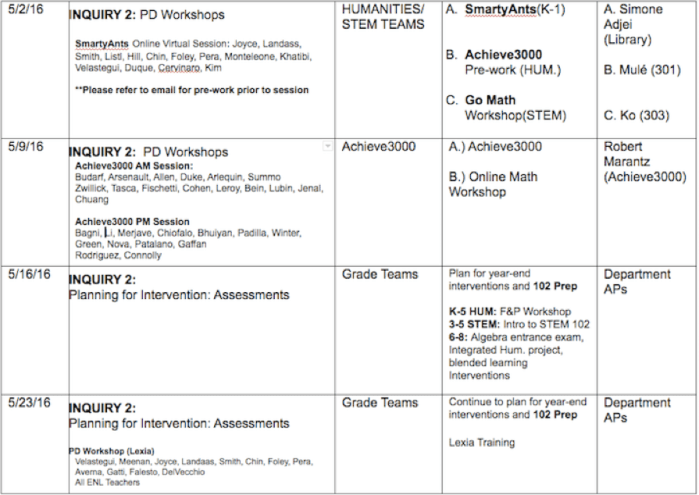
May Professional Learning: We will spend the majority of May learning about the programs we’ll use next year and June to actually plan for next year. Please see below for the most up to date PL calendar for May:Screen Shot 2018-05-27 at 10.20.07 PM 1.png

Email Supervisors In Case of Absences: I’ve made a request for staff to demonstrate the professional courtesy in emailing supervisors in case of absences once before, and it’s regrettable that I need to do so again. Let me be more clear this time by providing the rationale behind why it’s so important–but not contractually required–for you to do so. Skip to the next item if you already email me and cc APs when you are absent. (Thank you!)

Subcentral does not automatically generate emails/notices to secretaries and supervisors about staff that will be absent for the day. There is no glory in scheduling coverages: it is tedious and thankless work that is unnecessarily made more difficult when each supervisor has to log into the subcentral system to find out which teachers are absent and confirm which are already covered. The DOE’s Subcentral system was designed at a time when landline phone service was the primary and most efficient mode of communication: think about that.

If you’re still not convinced, imagine a scenario where you have to cancel an important lunch meeting with a family member, colleague, business partner, or perhaps your supervisor. Instead of texting or emailing the person directly to say you have to reschedule, you call the restaurant instead and ask them to pass the message along when the person you are to lunch with shows up to the restaurant alone. You’ve satisfied the restaurant’s cancellation policy, but probably not much else.

Things happen and there will always be times when we have to be absent. All I’m asking for is for all of us to do our best in making things easier for those who cover for us.

Sweet Pups Need You: Speaking of covering for those in times of need, thank you to everyone who informed us about two stray dogs that were roaming around our school lot Friday morning. Apparently the owner went away and the dogs were left without food and water. They were nothing but skin and bones when we found them, and I’ve never seen a bowl of water disappear so fast–a gallon in 10 seconds fast–when our kind staff brought them food and water. (Thank you Mr. Borelli, Ms. Delvechhio, Ms. Hassenbein, Mr. Rodriguez, and Ms. Beltran) We got them to Animal Control and I’m hoping that someone can adopt or at least foster them. Please spread the word; even in the backdrop against human cruelty they remain sweet and trusting the way only dogs do. Throughout the car ride they wouldn’t stop trying to come to the front seat to sit on my lap; it’s heartbreaking. Please email me if you can help.